



Photo by Chenyu Zhang, Untitled #2
by Yatharth Banerjee Singh
Read the Faculty Introduction
Abstract
Since the start of the millennium, film trailers have become a constant presence in the public eye, appearing across platforms from television to the internet. Many scholars view trailers or teasers as mere advertisements for films, which may account for the limited research on their significance beyond commercial purposes. By contrast, in this paper I look in-depth at the genre of trailers through a multimodal analysis of a prominent teaser released on April 3rd, 2019, for the psychological thriller film Joker. I analyze the teaser as an object, focusing on its use of visual, auditory, and verbal modalities. By contrasting these elements with the conventions typical of comic book entertainment films, I demonstrate how the teaser for Joker embraces controversy to engage audiences. Through this analysis, the paper contributes to a more nuanced understanding of the role of trailers in the superhero genre, highlighting how they shape audience perceptions and expectations beyond their immediate commercial function.
The Dangerous Allure of the Joker: A Multimodal Film Trailer Analysis
It's fair to assume that most people have seen at least one film trailer. With modern film releases routinely grossing upwards of $500 million, film trailers have become an integral part of a film's success, particularly within the superhero genre. Superhero movie trailers, typically one to three minutes long, are renowned for their meticulously curated action montages, epic one-liners, and sweeping cinematic shots designed to build anticipation for new releases. One trailer that stood out in its ability to captivate audiences was the teaser trailer for Todd Philips’s Joker. Despite initial skepticism about the film’s necessity—given the character's numerous on-screen appearances and enduring mystique—the teaser, released on April 3rd, 2019, generated a distinctive hype for the movie. Instead of adhering to the conventions of superhero film teasers, this unusually long teaser employed raw, gritty visuals, an intricately layered psychological soundscape, and dialogue focused on character-driven depth to craft the impression of a film grounded in reality—rendering it far more “dangerous” than conventional comic book films. By unapologetically presenting the film as “dangerous,” the teaser accomplished what very few films of its genre are capable of doing–using negative attention as a tool to garner box office success.
In its brief runtime, the teaser for Joker boldly diverges from genre conventions by presenting a gritty portrayal of Gotham that deliberately parallels contemporary society. Unlike the glossy and sanitized depiction of cities often seen in Marvel trailers, the teaser employs a drab, grainy color palette throughout to show a lifeless Gotham. Gotham, although fictional, is shown in a period of widespread urban decay, eerily reminiscent of New York City during the economic recession of the early 1980s. As M. Keith Booker observes, “the general atmosphere of Gotham City in Joker evokes a particularly difficult time in the history of New York City” (127), and the teaser’s visuals depicting run-down buildings, overflowing trash cans, and disillusioned citizens support this claim. This parallel adds depth to the teaser. By associating itself with real-world circumstances that many members of the film’s audience might even remember, the teaser comes across as a more grounded and socially resonant account of the city and by extension, our society.
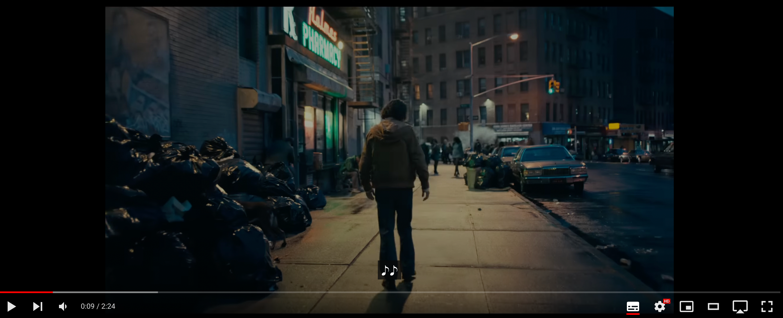
This focus on a gritty, relatable setting aligns with Christian R. Hoffman’s argument that a teaser's “primary function is to arouse the interest of the viewing audience and evoke the general ‘feel,’ mood or ambience or [sic] the feature film being promoted” (2). However, in this instance, the teaser goes beyond mere mood-setting; its visual depictions create a disquieting sense of realism that piques the audience's curiosity. By showing polarizing visuals such as the underclass rising up against the rich, set against a backdrop that feels uncomfortably close to our own reality, the teaser elevates itself not only generating interest but also sparking meaningful discourse. Consequently, numerous publications labeled the film as “dangerous” to society due to its supposed socialist undertones. The teaser, though, embraces this feeling of danger as a conduit to delve deeper into its core themes of societal neglect and mental illness.
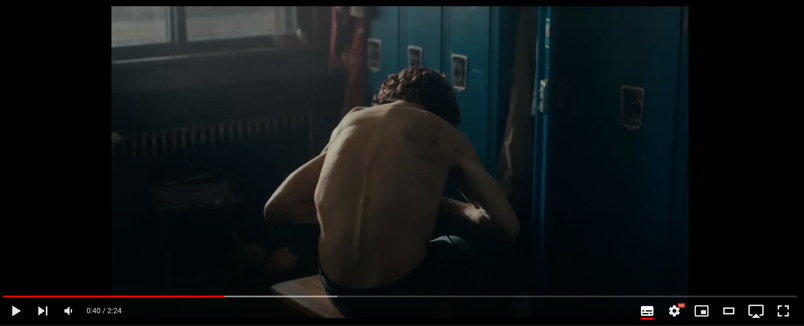
Transitioning from its realist version of Gotham, the teaser embraces its societal danger by leveraging its fast-paced nature to present the film’s genre as a psychological thriller that is both a “cautionary tale” and “gritty character study” (Warner Bros., qtd. in McNary). Unlike trailers that rely on large-scale action set pieces, the teaser uses close-up shots of Arthur Fleck (the character who ultimately transforms into the Joker) in scenes with minimal movement. The fear of him as a character is generated oddly enough by his physical weakness. In the teaser, we witness a hunched over, frail Arthur–a stark contrast to the physically imposing portrayal of supervillains in typical comic book film trailers (Warner Bros. 00:00:39-00:00:44). The fact that the teaser cuts almost suddenly on multiple occasions to show a bare-bodied Arthur whose frail body contorts disturbingly can be interpreted as a visceral representation of the trauma he has faced from society, especially given the teaser's placement of these scenes immediately after those depicting Arthur's physical abuse.
The fact that the teaser doesn’t adhere to the chronological order shown in the film, opting instead for a non-linear approach, intensifies suspense and the sense of “danger” among the audience, who remain unaware of Arthur’s journey and mental illness. How he will react to those who have done wrong is unclear from the teaser, and this lack of clarity compels viewers to want to know more about Arthur's story and the events that push him over the edge towards violence. However, beyond simply generating intrigue for the film, the teaser maintains its “dangerous” tone by intentionally withholding information, leaving much to the imagination. In contrast to the film, where Arthur’s story is contextualized, the teaser deliberately omits crucial aspects to enable the misinterpretation that the film glorifies incel culture in order to spark outrage. Severson argues that “[m]ore than anything, the Joker’s nihilism echoes that of hate groups in our own society, not unlike Gotham City’s,” and the teaser deliberately accentuates these parallels to real-world instances of individuals adopting the Joker persona. In doing so, it stokes controversy, compelling audiences to venture into theaters to discern whether the film is truly as “dangerous” as it is made out to be.
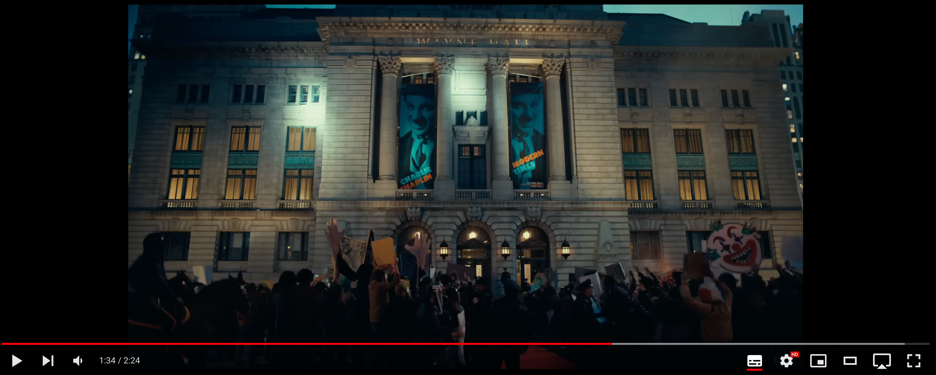
While the teaser’s visual elements undoubtedly contribute to setting the film's tone, it’s the auditory components that truly amplify its sense of “danger.” Morten Thomsen and Lene Heiselberg, commenting on the importance of music, believed that as trailers build up anticipation, “[r]hythm and music are thus among the defining characteristics of the trailer” (46). This emphasis on music as a reinforcement of the visuals is shown in the teaser as it uses a remastered version of the song “Smile,” originally written by Charlie Chaplin for his film Modern Times, to elevate itself beyond just a regular film teaser. Beyond a brief glimpse of a Modern Times poster in the teaser, the song's ironic reflection of Arthur Fleck’s fragmented mental state serves the teaser's goal of building negative hype around the film. By deliberately referencing Modern Times, a film known for its critique of capitalist modes of production, the teaser further enhances its associations with supposedly “dangerous” messages in American society. A more nuanced interpretation of the song’s hollow optimism reveals the paradox inherent in its lyrics, where the singer is telling the listener to cheer up and that there is always a bright tomorrow, just as long as they smile. In this way, the teaser manipulates the critique embedded in Modern Times to further stir controversy and propel the film's provocative allure.
Furthermore, the song is also strategically used to invoke some kind of sympathy (pathos) for the protagonist, a dangerous idea in itself. The song’s main verse, “[s]mile though your heart is aching,” plays over a pivotal scene (Warner Bros. 00:01:08-00:01:12) where Arthur sits in front of the mirror trying to force himself to smile with a tear rolling down his eye as he struggles to do so. Instead of the quippy dialogues seen in usual Marvel trailers, the audience is forced to interpret Joker’s emotions and motivations based on the song and his expressions, almost as if they are sympathizing momentarily with a real person. This portrayal of Arthur as both a victim and a villain, with a focus on his victimhood in the teaser as he isn’t shown committing any crimes in the teaser, contributes to the aura of “danger” surrounding the film. The deliberate lack of action on his part is supplanted by the teaser’s clever manipulation of verbal elements, furthering the notion that the film is one that warrants cautionary attention.
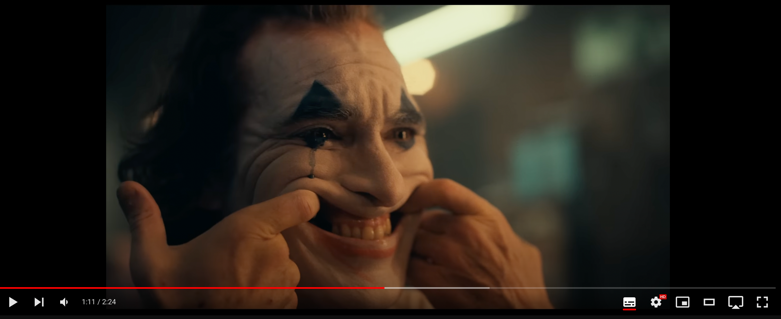
The Joker teaser complements its striking visuals and music with powerful character-driven voiceover dialogue, heightening the film’s allure. Jörg Finsterwalder et al. note how, for most viewers, “the quality of the dialogue revealed in the trailer is indicative of the quality of the dialogue in the film and thus influences their expectations of the film” (592-593). Throughout the teaser, there is no scene in which the Joker speaks directly to the camera; instead, all of his lines are delivered in voiceover. Joker’s pivotal line “[i]s it just me, or is it getting crazier out there?” (Warner Bros. 00:00:39-00:00:42) is delivered in voiceover, imbued with an unsettling ambiguity. By relying solely on voiceover, the teaser keeps the audience locked inside Arthur's head. We hear his observations and thoughts, but we don't necessarily see the world through his eyes. This disconnect, coupled with the ambiguity surrounding his mental state and motivations, fuels the film’s reputation as “dangerous.” Raising concerns about the glorification of violence and mental illness, the teaser avoids depicting Arthur’s wrongdoings almost entirely. Instead, it culminates in a final scene that evokes fear of a monster like the Joker emerging from a society akin to ours in its craziest form.
While the teaser uses gritty visuals, melancholic music, and weighty dialogues throughout, it is the final scene that unequivocally cements the film's “dangerous” nature. Contrasting Arthur’s earlier walk up the stairs as a broken man with the final confident embodiment of the Joker feels almost hypnotic. His shift in posture and movement isn't a typical supervillain transformation sequence with special effects. Instead, it's a subtle yet unsettling shift where Joker defiantly declares, "I used to think that my life was a tragedy, but now I realize it’s a comedy" (Warner Bros. 00:01:49-00:02:03). Accompanied by ominous music, this moment marks a pivotal shift in perception, from viewing hardships as overwhelming tragedies to embracing the absurdity of existence. The dissonance between Joker's newfound perspective and the audience's interpretation reflects the teaser's ability to unsettle and captivate, leaving viewers to ponder the consequences of sympathizing with such a realistic psychopath.
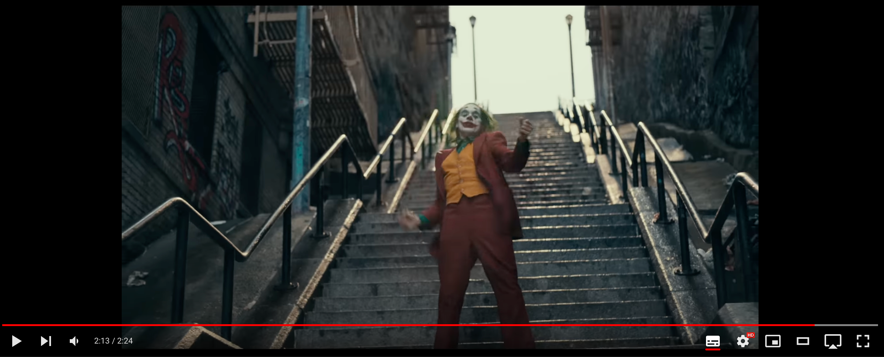
To conclude, rather than shying away from the label of being a divisive and “dangerous” film, the teaser uses its short duration to boldly embrace this label by tapping into existing controversial ideas in society to generate hype. The chaotic nature of the teaser which flip-flops between ideas is thus amalgamated by its modalities which coalesce to fulfill its central aim to make us feel that by watching the film we are, in some way, posing a threat to the establishment. Through its gritty cityscapes, non-linear narrative, and melancholic score, the teaser deliberately taps into socio-political undercurrents in American society to evoke both a pervasive sense of fear yet intrigue. A comment on YouTube encapsulates this contrasting sentiment perfectly: “My siblings: Why do you still watch this trailer after watching the movie? Me: You wouldn’t get it” (comment under Warner Bros. 2019). This remark, referencing a line from the film, shows how the teaser served not only as a promotional tool that made audiences scared yet hooked, but also as a piece of standalone entertainment. Moving forward, further research could explore how other teasers employ similar tactics to sensationalize or even intentionally mislead audiences. What are the implications of such strategies, particularly in an era where shorter content often amplifies controversy and cultural upheaval? Ultimately, the teaser’s success lies in its ability to unsettle and captivate, proving that even in its brevity that allure of danger is just as powerful as the promise of entertainment.

Works Cited
Booker, M. Keith. No Joke: Todd Phillips’s Joker and American Culture. Liverpool University Press, 2023.
Finsterwalder, Jörg, et al. “The effects of film trailers on shaping consumer expectations in the entertainment industry—a qualitative analysis.” Journal of Retailing and Consumer Services, vol. 19, no. 6, Nov. 2012, pp. 589–595, https://doi.org/10.1016/j.jretconser.2012.07.004.
Hoffmann, Christian R. “Cut to the Chase – How Multimodal Cohesion Secures Narrative Orientation in Film Trailers.” Discourse, Context & Media, vol. 44, Dec. 2021, p. 100539, https://doi.org/10.1016/j.dcm.2021.100539.
McNary, Dave. “Joaquin Phoenix’s ‘Joker’ Movie Gets Release Date.” Variety, 18 July 2018, variety.com/2018/film/news/joaquin-phoenix-joker-movie-release-date-1202877605/.
Severson, Ken. “Is ‘Joker’ Dangerous? The Joker Movie Controversy, Explained.” StudioBinder, 14 June 2020, www.studiobinder.com/blog/joker-movie-controversy/.
Thomsen, Morten, and Lene Heiselberg. “Arousing the Audience: The Two-Peak Structure of Drama Film Trailers.” Journal of Scandinavian Cinema, vol. 10, no. 1, Mar. 2020, pp. 45–65, https://doi.org/10.1386/jsca_00013_1.
Warner Bros. Pictures. “Joker - Teaser Trailer - Now Playing in Theaters.” YouTube, 3 Apr. 2019, www.youtube.com/watch?v=t433PEQGErc.