




Photo by Cheng, Untitled
by Yutong Zhao
Read the Faculty Introduction
When you walk around on a street in New York, you can always see some busy bees with blue uniforms shuttling through the city. They are the delivery workers from Amazon. Hundreds of thousands of them run between warehouses and consumers' homes, maintaining the daily necessities of people's lives. Amazon has become an indispensable part of American life. Whether it's furniture, books, or appliances, with just a few taps on the keyboard and clicks of the mouse on Amazon's website, Amazon Blue Warriors will deliver the goods to your hands in just a few days. But in China, with its huge population and vast market, you won't see any trace of Amazon. How could a giant company like Amazon not try to tap into the massive Chinese market? In fact, Amazon did try, but it failed. For most Chinese people, Amazon is like a distant relative—a familiar name but rarely visited. In June 2019, Amazon announced that it was closing its domestic e-commerce business in China. Instead of buying products sold locally by Amazon and its marketplace of Chinese suppliers, shoppers at Amazon will only be able to buy imported products, which also signifies the failure of Amazon China (Weise). What led to the failure of the business giant Amazon in China? Apart from the reasons related to Chinese government policies, the root of its failure is its lack of localization.
Amazon’s business model helped it become a giant in America. In the book Monopolized Life in the Age of Corporate Power, David Dayen writes about the prime strategies used by Amazon to attract customers and gain the market. Amazon Prime members can enjoy free two-day delivery services, which greatly attracts American consumers facing the expensive cost of human delivery in the United States. Dayen writes that “Amazon knows that capturing customers in its Prime netting encourages them to buy more, to make the $119 annual fee worthwhile” (193). This shows that Amazon’s goal is to use its delivery services to attract customers to pay for this Prime membership, and then make use of consumers' desire to recoup their membership fees to encourage them to purchase more products on the Amazon website. To facilitate fast delivery, Amazon has also built many large warehouses across the country to store its products (Dayen 194). These strategies have helped Amazon succeed in countries like the United States and other nations with similar consumer habits, such as European countries and Japan. However, they became the root cause of its failure in China.
“Think global, act local.” This is a well-known mantra, but Amazon only did the first half of the sentence in the Chinese market, and the last half is the key to its failure. Ker Zheng, the marketing specialist at Shenzhen-based e-commerce consultancy Azoya, pointed out in an interview with DW.com that "Amazon didn't really localize its product enough because its [Chinese] user interface had to align with the company's other global platforms" (Martin). This clearly points out the flaws in Amazon's approach to the Chinese market. The Chinese market has the characteristics of high efficiency, no matter for the delivery service or for the customer hotline service. This is due to their massive population and abundant labor supply. Moreover, unlike the Japanese markets at that time, the level of Westernization in the Chinese market was not that deep, and customers still had strong preferences for local cultural elements (Weise). However, in pursuit of a uniform global market chain, Amazon did not customize its operating model according to the characteristics of the Chinese market. As a result, it ultimately lost the Chinese market. After further research, the lack of localization of Amazon in the Chinese market can be divided into three aspects: operating model, customer service, and cultural adaptation.
To begin with, Amazon’s operating model in China didn’t adapt to local customers’ payment habits and also didn’t make use of local delivery service. Just like in the US market, Amazon spent billions building 15 warehouses in China and built its own domestic delivery infrastructure to store and distribute goods (Tullman). However, it overlooked the existence of third-party delivery services in China, which are well-developed and already have a vast market. In contrast, Amazon's competitor, Jing Dong, not only has its own JD delivery but also collaborates with other small delivery companies such as Cai Niao and Yun Da (Weise). This not only saves the cost of building warehouses but also makes the delivery service more convenient and efficient because these small delivery companies have distribution sites scattered all over the place, which makes them quickly complete delivery tasks nearby. Moreover, when Amazon entered the Chinese market, Alibaba had already launched Alipay. As a domestic payment software in China, Alipay has connected the consumption lives of Chinese consumers into a convenient payment chain. Chinese consumers gradually became accustomed to using Alipay for any consumption (Cebeci). However, shopping on the Amazon website still requires linking a bank card or Apple Pay, which contradicts the consumption and payment habits that many Chinese consumers have already formed. As a result, Amazon has lost a large number of Chinese consumers.
Furthermore, Amazon’s customer service can’t meet Chinese customers' standards. Amazon's Prime service offers free two-day delivery, but other Chinese domestic e-commerce platforms such as Jing Dong and Tao Bao provide free same-day delivery without requiring consumers to register for Prime (Keyes). This not only diminishes the attractiveness of Amazon's prime strategy but also puts its delivery speed at a disadvantage compared to other Chinese e-commerce platforms. In addition, Amazon's customer service has been heavily criticized. Compared to platforms like Taobao and JD.com, which offer customer service almost around the clock, Amazon's customer service is often described by consumers as slow and of poor quality (Tullman). Sometimes it's difficult to reach the customer service hotline, and even when you do, the speed of problem resolution is unsatisfactory (Keyes). “The customer service rep of Amazon was just copying and pasting answers on the chat, trying to rush you out of the chat or the phone, they don’t care about the particulars of your issues at all,” one customer told DW in the interview (Martin). These shortcomings have caused Amazon to lose its competitive edge in an era where online shopping service expectations are rising in Chinese customers’ hearts, leading to a loss of consumer favor.
Last but not least, Amazon didn’t match Chinese customer’s cultural preferences. Amazon's website design has received widespread criticism in China. The pictures below are the web pages of Amazon and Jing Dong, from which we can see a clear difference between their design styles (see Fig. 1 and Fig. 2).
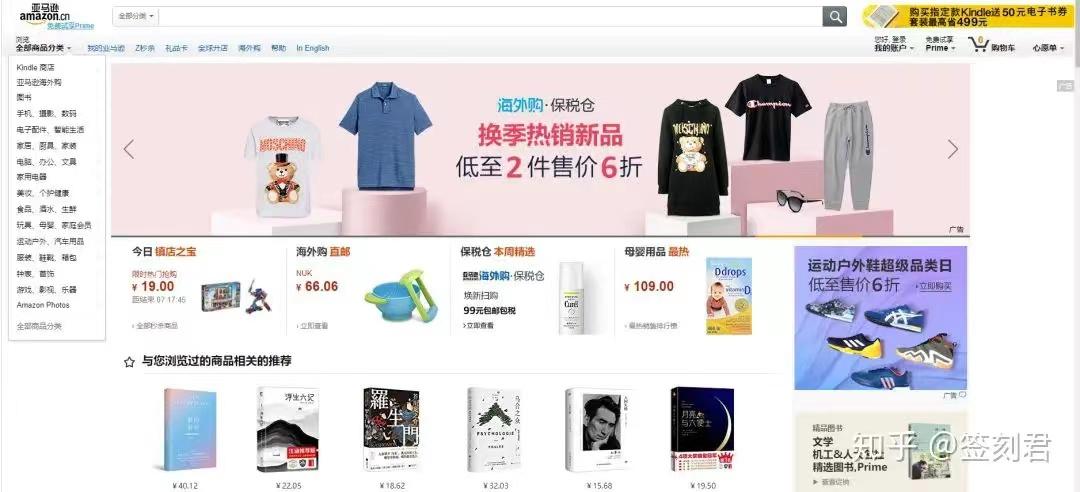
Fig. 1. Webpage of Amazon.
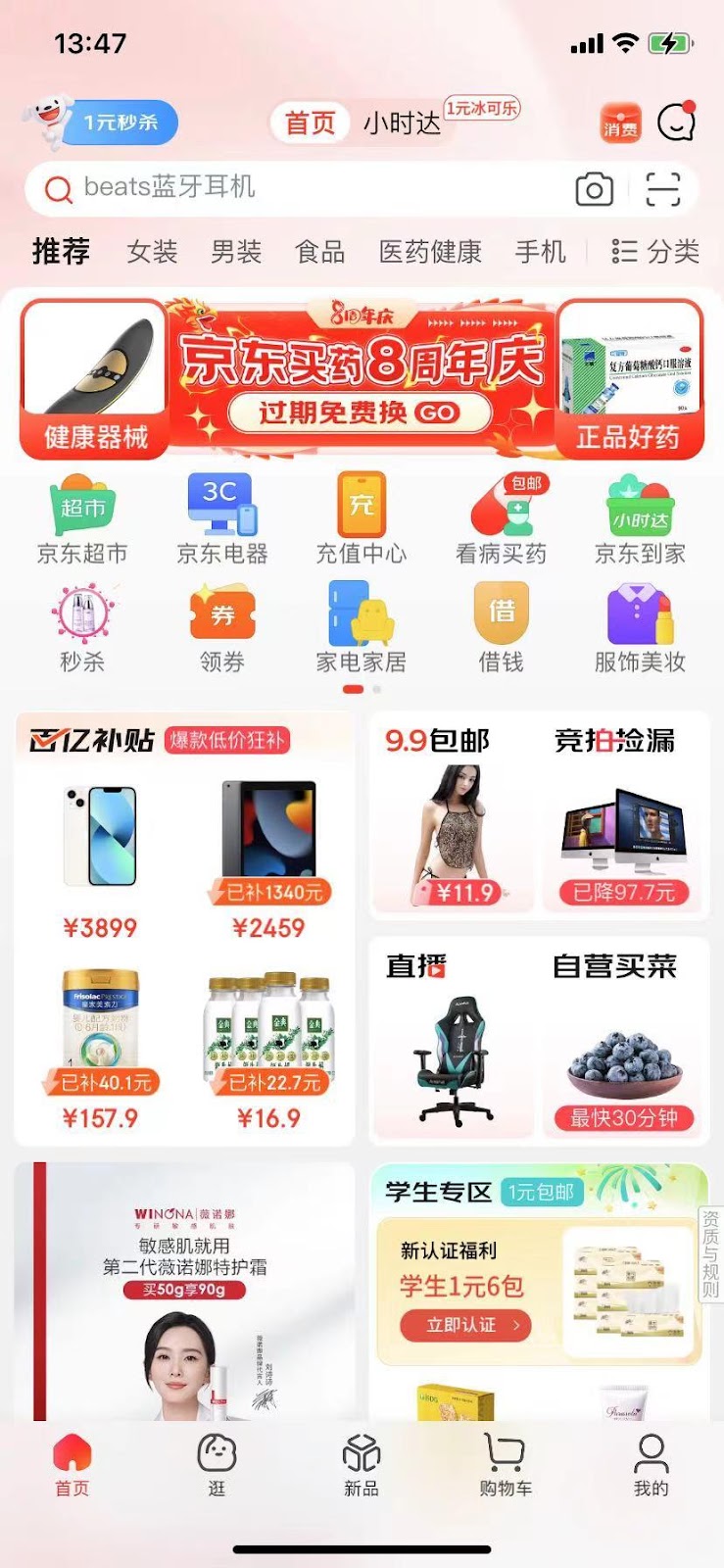
Fig. 2. Webpage of Taobao.
Amazon has always maintained its minimalist and simple webpage design style. From the first picture, we can see that Amazon’s interface typically displays product images and prices clearly, without too many flashy advertisements. In contrast, the second image of JD.com uses a vibrant and colorful interface design, with each functional model represented by corresponding graphics. The images and prices in the advertisements are also more attractive. The blueberries in the picture look very fresh and enticing, and the caption below reads “Delivered in as fast as 30 minutes.” “American consumers prefer a more simple, minimalist design, but Chinese consumers prefer more vibrant designs,” said Ker Zheng (Martin). Amazon also did not leverage the unique Double Eleven shopping festival in the Chinese market but continued its tradition of Prime Day promotions (Cebeci). The Double Eleven shopping festival is not just an opportunity for Chinese e-commerce platforms to sell products; it's also a chance for them to engage consumers and foster goodwill towards their platforms. Consumers compare the consumption activities launched by various platforms during the Double Eleven shopping festival, influencing their choice of long-term consumption platforms (Sarris 24). However, Amazon did not adapt to the trend of Chinese online shopping culture. As a result, it was gradually engulfed by the rise of Chinese e-commerce and eventually forgotten and abandoned by Chinese consumers.
In conclusion, the fundamental reason for Amazon's failure in the Chinese market is its failure to adapt to the preferences of local consumers. For example, it did not adapt to Chinese customers’ preference for more elaborate website designs and the habit of using Alipay for payments. Additionally, it did not effectively leverage some of the business partnerships available in the Chinese market, such as third-party delivery services. In the burgeoning wave of the Chinese e-commerce industry, consumer demands dictate the direction of businesses. However, Amazon didn’t meet the tastes of Chinese consumers and persisted with its traditional approach of attracting consumers through Prime and supporting logistics with large warehouses. It fought a lone battle in China, ultimately experiencing the bitter taste of failure due to its lack of localization efforts, which can also serve as a lesson for other foreign companies looking to enter the Chinese market.
Works Cited
Cebeci, Dila. “Why Amazon Failed in China - the One That Got Away.” Transport Intelligence, 18 Feb. 2020, www.ti-insight.com/briefs/why-amazon-failed-in-china-the-one-that-got-away/. Accessed 24 Apr. 2024
Dayen, David. Chapter 8. Monopolized: Life in the Age of Corporate Power, The New Press, New York, 2020, pp. 191–214, http://ebookcentral.proquest.com/lib/nyulibrary-ebooks/detail.action?docID=5837095. Accessed 24 Apr. 2024.
Keyes, Daniel. “Amazon Is Struggling to Find Its Place China.” Business Insider, 30 Aug. 2017, www.businessinsider.com/amazon-is-struggling-to-find-its-place-china-2017-8. Accessed 24 Apr. 2024
Martin, Nik. “Why Amazon Struggled to Beat Alibaba in China – DW – 04/19/2019.” Dw.Com, Deutsche Welle, 19 Apr. 2019, www.dw.com/en/why-amazon-struggled-to-beat-alibaba-online-in-china/a-48403733. Accessed 24 Apr. 2024
Sarris, Nick. “Amazon and Alibaba: How Cultural Misunderstandings Precede Failure in International Markets.” Undergraduate Thesis, University of Virginia, 2020, https://doi.org/10.18130/v3-f220-v772. Accessed 24 Apr. 2024.
Tullman, Howard. “Amazon’s Amazing Failure in China.” Inc., 30 Apr. 2019, www.inc.com/howard-tullman/chinas-amazing-failure-in-china.html. Accessed 24 Apr. 2024
Weise, Karen. “Amazon Gives up on Chinese Domestic Shopping Business.” The New York Times, 18 Apr. 2019, www.nytimes.com/2019/04/18/technology/amazon-china.html. Accessed 24 Apr. 2024
"Jingdong – zhengpin dijia, pinzhi baozhang, peisong jishi, qingsong..." 京东 – 正品低价、品质保障、配送及时、轻松... [JD.com – Authentic Products at Low Prices, Quality Assurance, Timely Delivery, and Ease]. JD.com. Accessed 25 Apr. 2024.