


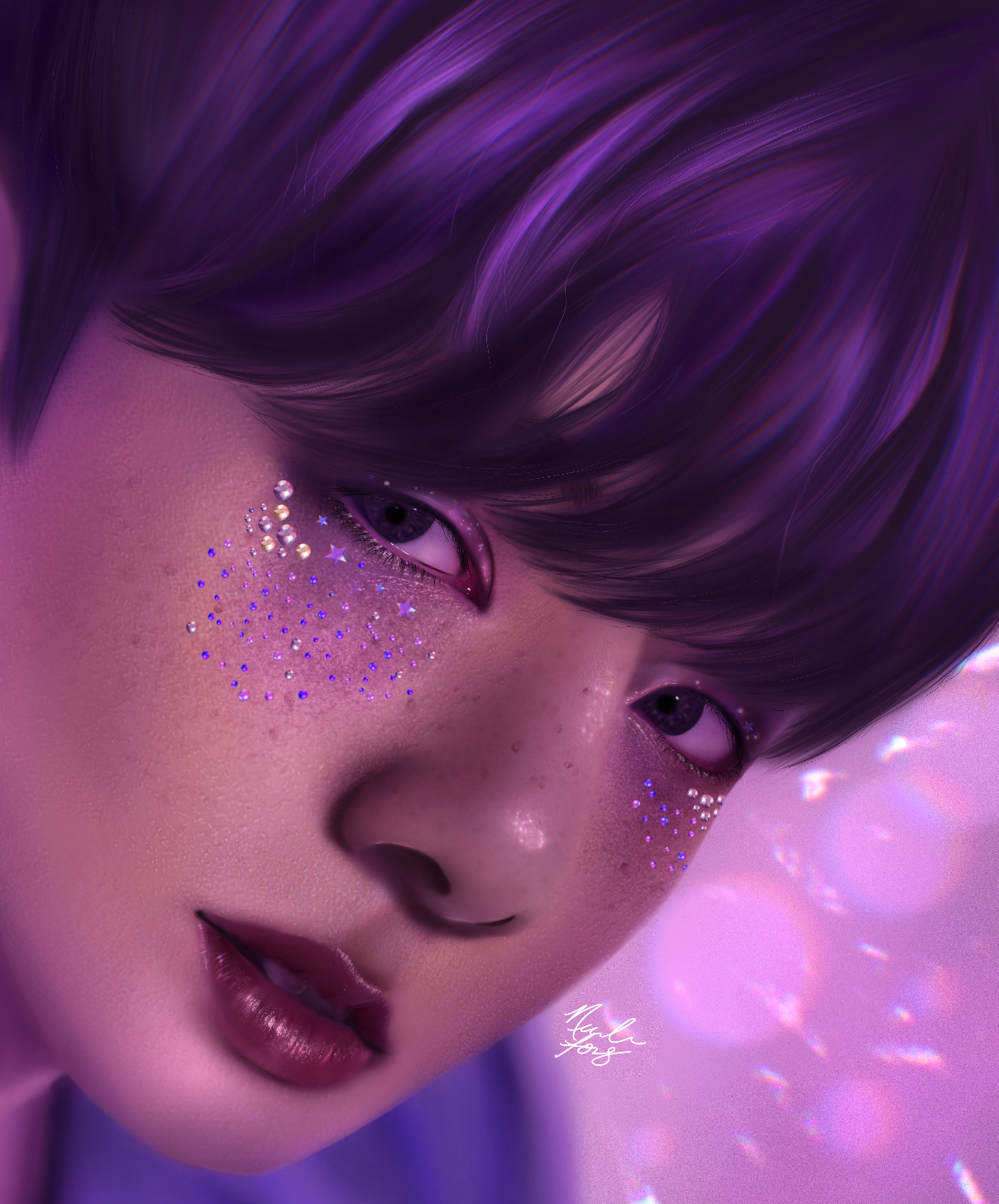
Photo by Nicole Fong, Ilustración sin título
by Addie Dung Manh Nguyen
Read the Faculty Introduction
Blinding lights flickered, and darkness was on all sides. The truck slowed down as it wriggled through the tiny alleys lined with bustling street vendors. It was only 4 in the morning, and the sun had barely risen on the horizon. In fact, it was hardly a sunny day in April. Amidst the honking of the truck’s horn and the suffocating hustle and bustle of the market, Madam Phung’s Last Journey, the premỉer work by the Vietnamese amateur director Tham Nguyen, began unfolding. As the troupe, men and women and young and old, arrived at an abandoned stadium and descended from the vehicle, their hands held firmly onto steel bars, tarp sheets, and raffle cages. On another truck piled bags of colorful costumes–cocktail dresses, feather coats, and embellished gowns–the kind bought from Chinese factories and not the luxury ateliers. By then, one could already tell that the troupe members were no ordinary entertainers. After an entire day of drenching in the ricocheting rain to assemble the carnival houses, the ground finally parched, and colorful flags finally waved in the blinding lights. In the blaring sound of Little Ut promoting the variety show about to begin in the neighborhood, Madam Phung and her best disciple, Little Phung, rushed to zip up their best gowns and meticulously add the finishing touches to their heavy makeup, already three shades lighter than their bronze skins. The music was on, and, with the crowd gradually filling up the stadium, began the duo’s performance–a quirky mix of Cai Luong (Southern Vietnamese folk opera), Cuban bolero, and disco rock. While the two Phungs lived their ecstatic moments in the flickering stage lights, their sisters passed on to the galvanized audience their lottery tickets, a black-and-white pamphlet-sized ticket with random numbers, as random as the list of songs in today’s line-up. Their choice of music and lighting was so wild and explosive as if it was revolting against the darkness and silence that had long besieged the village. Elsewhere, other women in their sequined dresses hosted merry-go-rounds for the kids and hamster races for gamblers. As Madam Phung wound down and receded from the stage, her best friend, Madam Hang, rocked the stage with her one-of-a-kind lottery drawing, announcing random numbers she had drawn somewhere in her improv lyrics. “What is the number? What is the number?” she continuously sang while the cages spun at the speed of light upon the audience’s anticipation. Hours passed, and her acts eventually ended with an empty audience beneath and her breathless voice; the troupe was already dismantling the entire carnival for their next day on the road to the next city. It was Madam Phung’s last journey in the invisible shadow across Vietnam: fast came, fast went, without a trace by the next morning.
This was the reality of Madam Phung’s troupe and another handful of Lô Tô troupes across Vietnam. Through the lens of Director Tham Nguyen, the Vietnamese public caught a glimpse into the ephemeral glamour of these Lô Tô troupes, and, to many, it was a bitter pill to swallow, given that Vietnam was fast becoming one of the most LGBTQ-friendly nations in Asia. Frequently associated with transgender women and queer men, Lô Tô troupes have long operated in an environment shrouded by obscurity and uncertainty, bouncing between the Southern provinces (whose political culture has been more inclusive than that of their deeply conservative Northern counterparts) outside of any legal protections in a nation that has yet to fully recognize the complex identities inside these troupes. Upon examining the dynamics within the LGBTQ+ community in Vietnam, a 2017 ethnographic research by scholar Yen Mai adopted the term “homonormativity” to account for the disparity in the perceived acceptance of various identities. In Mai’s study and this essay, homonormativity is defined as the expected course of action and code of social conduct that individuals within the LGBTQ+ community should follow, whereas heteronormativity applies to cisgender heterosexual individuals. Taking into account entries in Mai’s interviews and the harsh reality depicted in “The Last Journey of Madam Phung,” transgender women have been at the bottom of a hierarchy of normativity that has subjected them to inescapable poverty and further discrimination (“Constructing Queerness” 401–402). Upon deeper analysis by Mai, however, this homonormativity revealed itself to be an extension of the heteronormative Chinese, Western, and Socialist ideologies that have long implied the importance of gender stereotypes and socially constructed (acquired) morality in queer identities within Vietnamese society (407). By extrapolating the established Chinese, Western, and Socialist notions of heteronormativity and modern homonormativity in Vietnam to the underrepresentation of transgender women in Lô Tô, this essay seeks to frame Lô Tô as a symbol of resistance against the foreign appropriation of Vietnamese folk culture worthy of formal recognition and preservation. As Vietnam strides toward a more socially progressive political culture, such recognition could advance and integrate critical discourses on LGBTQ+ rights as a long-standing tradition (not an imported concept from Western nations) into Vietnamese civil society beyond the mere societal tolerance at present.
To fully grasp the cultural and historical significance of Lô Tô, it is essential to trace its origins. Like many aspects of Vietnamese folk culture, Lô Tô had its humble beginning in colonial roots, specifically in the Italian game Lotto during the French colonial rule (Vu), yet it has since evolved into a vibrant mosaic of both Western and Vietnamese cultural elements. Throughout the early 20th century, with the French colonialist government’s crackdown on traditional performance arts, the original European game ultimately merged with Vietnamese opera and folk singing. By the 1960s, under the gigantic American influence in the South, Lô Tô had incorporated components of the Western carnival culture to form its modern version dissected in “The Last Journey of Madam Phung” (Vu).
With this constant evolution came a new social function for Lô Tô. Starting from the 1950s onward, troupes of Lô Tô became a haven for queer men and transgender women as the emblem of free self-expression. For once, the legal status of Lô Tô was ambiguous in South Vietnam during the 1960s. In an excerpt from 1960 from the Hợp-tác và Nông-tín internal magazine (affiliated with the South Vietnamese government), Lô Tô was viewed as gambling yet “should not be regulated by law” since it was an “established tradition during Tet” (Vietnamese New Year) (Quốc Gia Nông Tín Cuộc). This created the perfect environment for Lô Tô to establish itself outside conventional cultural mediums as an outcast. Its unique position was further corroborated for much of its existence during the 20th century as it contributed to the preservation of the more formal traditional heritages, such as Bài Chòi (Vietnamese cards played in a bamboo hut) and Cải Lương (Vietnamese folk opera), under the disguise of propagating modern-styled entertainment when political attitudes toward traditional Vietnamese culture reached their hostility climax.
The exclusion of Lô Tô from conventional mediums persisted into the post-colonial era. Once colonialism was no longer holding Vietnam hostage, socialism weaved itself into the Vietnamese political culture. After the country’s reunification under one socialist government, Lô Tô was listed as a form of gambling in light of the post-war cultural revolution. Its association with homosexuality and transgenderism made it a thorn in the eyes of authorities, thus excluding it from the defined sets of Vietnamese cultural heritages. Although there was no official ban on Lô Tô, troupes constantly had to evade the authorities’ inspections and raids against the so-called “social evils” (a concept this essay will later delve into). Yet, this period of heavy persecution was also Lô Tô’s golden era (Danh). With its extralegal status, Lô Tô avoided the excessive surveillance and censorship that tightly gripped other established traditions: for once, people took joy in the jubilant Lô Tô carnivals, the kind of intangible joy untouched by any national political agendas. Lô Tô eventually struck permanent roots in Southern Vietnam, especially in the Southwest, where the flatlands and intricate river systems in the Mekong Delta catered to the troupes’ escape from the endless bounty hunts of the local government. From here, Lô Tô was tied to the image of constant elusion between the makeshift ferry slips along the rivers of the Southwest, only to appear in the glorious extravaganza costumes amidst the blinding lights of the stages. This image would last almost until the late 2010s when regulations on Lô Tô troupes loosened. As Lô Tô stepped into the limelight, troupes like Madam Phung’s began their tours across the country on paved roads, not rivers. Nevertheless, as her troupe traversed through Southern Vietnam, they were met with a lukewarm and occasionally hostile reception from the local community and the authorities, who, upon every arrival, would request a stay permit for the nomadic group as the typical bureaucratic “torture” welcoming them. Tham Nguyen–the film’s director–took careful note of this in an interview with Vice News as she accompanied the troupe, “From what I witnessed, every time the troupe went to a new area…they were always teased and people touched them, children threw stones at them” (Osborne). Her frames stacked the dimly lit darkness in the rural villages and the potential hostility emerging from it onto the desperation drowning the troupe’s morale. No one knew what would happen to the troupe once they arrived in a new place, and no one with a rational mind would honestly expect peaceful days ahead for the troupe.
This extralegal (and, in some cases, informally illegal) status of Lô Tô intertwines with the ambiguity in the self-identification of Vietnamese transgender women as a whole. In their pioneering report on the Vietnamese transgender community in 2012, Pham et al. noted the confusion that transgender people face in determining their authentic identities (22). “As the transgender concept is quite new in Vietnam and used to be understood to include only those who have had sex reassignment surgery (like famous celebrities Cindy Thai Tai, Cat Tuyen, etc.), it is common for transgender people to think that they are homosexual based on the gender of the ones they love, i.e. being les (if born with a female body and attracted to women), or gay (born with male body but attracted to men)” (Pham et al. 22). The researchers then advance, “Self-identification, therefore, significantly depends on a person’s knowledge and their endeavours to acquire knowledge on self-identification” (Pham et al. 22). In the movie, the Bich Phung troupe themselves featured a mix of queer men and transgender women, where the differentiation between accurate labels for their gender identities and sexual orientations was blurry and obsolete. All non-heterosexual sexualities in the troupe were referred to under the umbrella terms “bóng (gió)” (“shadow/spirit in the wind”) or “bê đê” (originated from the French pédérastie, equivalent to “fag”).
One signature commonality between these Lô Tô entertainers and most transgender women in Vietnam in this era was the embracing of a hyperfeminine appearance in order to align with physical and mental perceptions of femininity in their consciousness. Various scenes in the documentary closely dissect the stereotypical figure of transgender women with hyperbolic features that radiate femininity: overfilled lips, extravagant sizes of breast implants, cut-out cocktail dresses, and curly wigs. Nevertheless, throughout the movie, scattered snapshots of masculinity underneath the thick makeup layers show these brave trans women brawling with outsiders, mostly hostile and male, to protect the troupe. It is ironic even to witness how, without the makeup and breast pads, they managed to chase after the vandals and crush their motorbikes in half, to the police’s surprise (T. Nguyen 25:40–27:00). These bursts of physical strength, however, were far from being unexpected occurrences: perhaps they were a natural response to the constant vandalization and discrimination sanctioned by outsiders and the authorities. Elsewhere, the game stalls were erected entirely from the younger women’s collective effort, while Madam Phung was seen soaking in the rain, rolling around, and doing a somersault (T. Nguyen 32:16–32:33), all of which arguably feminine women (in the purest Vietnamese sense of the word) rarely do. Nonetheless, intolerance against transgender women, especially within these Lô Tô troupes, perhaps stemmed from this disparity between the enhanced perception of femininity above and the existence of masculinity found in their inner selves. In the excerpts from Mai’s interviews with gay individuals, they “found [trans women’s] bodies appalling and not entitled to be visible.” “[Female transgender] bodies are depicted as ‘unnatural’ and worthy of contempt, and are constantly subjected to contestations from gay men” because the stereotypical figure conjures a sense of incoherence (Mai, “Constructing Queerness” 401). One could argue that such prejudice would be more reinforced in the case of trans women in the Lô Tô troupes, within whom the discrepancy between the hyperfeminine code of conduct and a masculine inner-self is inevitably wider.
This partially explains why, although the LGBTQ+ community in Vietnam has achieved significant milestones for greater equality in recent years, transgender women, especially in Lô Tô troupes, remained at the bottom of this homonormative hierarchy (Mai 401). In a comprehensive survey of LGBTQ+ groups across Vietnam, researchers and activists Huy T. Luong (the first openly queer man running for office in the Vietnamese National Assembly) and Phuong Q. Pham reported that out of all the groups surveyed, transgender women had the highest likelihood of being disowned by their families, experiencing physical assault, and, in a uniquely Vietnamese sense of transphobia, being forced to go through rituals (45). In schools and workplaces, transgender women are more likely to drop out and be denied occupational opportunities, social security benefits, and promotional prospects (Luong and Pham 51, 56). With challenges on all sides and without practical legal protection, queer and transgender teenagers have been exercising agency over their lives in non-conforming ways to resist heteronormativity (Mai, “Expressions of Agency” 56–57). This justifies why many, such as in the case of the Bich Phung troupe, saw Madam Phung’s Lô Tô business as their sole livelihood and a haven for their performative passions. Zoom out, and it is no surprise that Lô Tô has continued to exist as a sanctuary for transgender women in a nation that denies them the right to free expression without being censored.
We have so far established that modern homonormativity in Vietnam excludes transgender women in Lô Tô from the rest of the LGBTQ+ community and important discourses that affect their day-to-day livelihoods. However, the history behind this established homonormativity can be traced back to multiple ideologies that had historically overarched the Vietnamese political culture for decades, if not centuries. One of which is Chinese Confucianism, one of the “three teachings” (tam giáo) in the traditional East Asian culture. For a millennium of Chinese colonialism, from 111 BCE–939 CE, the Vietnamese judicial and societal modes were significantly modified to accommodate Confucian values up until the 1910s (Gardner 9), constructing the primitive version of Vietnamese heteronormativity. As Confucianism interacted with existing Vietnamese cultural values, Confucian heteronormativity gradually encompassed the moral prospects of aligning oneself with family values and preserving the lineage while fulfilling their social-familial role in their biological sex, all of which transgender women could hardly satisfy. In their analysis of the impact that Confucianism had on perceptions of non-heterosexuality in Modern Vietnam, authors Tam Nguyen and Holly Angelique noted the Confucian monopoly on the interpretation of family in Vietnam, “It describes family in strict heterosexual terms and gives the concept of family the utmost importance in defining one’s self-worth and dictating one’s position in community life. There could be no worse fate than to bring shame upon one’s family” (1618). In this Confucian interpretation, within the patrilineal kinship system, men are elevated as active participants in maintaining it, while women are relegated to subordinate positions, unable to attain equal status (Nguyen and Angelique 1618).
This societal framework arguably imposed a dual burden on transgender women, devaluing their status upon their transition and burdening them with the invisible expectation of extending the patriarchal lineage. As such, in the movie, there was a scene where Madam Phung, born as her family’s sole son, recounted her son’s adoption, a decision made so that her parents would finally have a “cháu nội” (paternal grandchild) (T. Nguyen 22:46–23:17). She did not adopt a daughter, and her son did not call her parents maternal grannies, all in the name of the patrilineal kinship. Moreover, Confucianism's emphasis on acquired morality marginalized transgender individuals as they struggled to adhere to societal virtues deeply ingrained in Confucian thought. Biologically, most transgender women, upon their transition and hormone treatment, became sterile. In Vietnam, that sterility translates to “impiety, disappointing parents, disrupting family lineage, and bringing shame upon one’s family” (Nguyen and Angelique 1620), forming a vicious cycle in which the acquired morality of transgender women has been perpetually diminished. Seeking redemption for their perceived moral shortcomings, many transgender women turned to religion, as exemplified by Madam Phung's brief stint as a Buddhist monk prior to assuming leadership of the troupe. Aside from Madam Phung’s story, Buddhist statues would occasionally appear next to the women’s beds or in the corners of the carnival stalls. Behind the screen of cigarette smoke, they yielded themselves to the statues while the Buddhist Dharma blasted through the loudspeaker, praying to the non-judgmental Buddha above that their hard days would finally pass. Most catastrophic of all, however, the absence of non-heterosexual representations within Confucian philosophy and other ideologies in the “three teachings” (including Buddhism, the religion that many Lô Tô women adhered to) perpetuated the notion that non-heteronormative identities are foreign imports, alien to Vietnamese cultural heritage (Blanc 663–664). The women, hence, became aliens in their own country and in the language that they spoke. Thus, there was no room for them in the words they used referring to their identities and no room for them in the legal system, in the family structure, and in the culture that nourished them: their struggles were a foreign disease, and as other diseases, it must be quarantined from the rest of the society.
As the independence of feudalist Vietnam came to a halt, Confucianism soon assumed a lackluster position and was later substituted with Western-Christian colonialism. Christianity reached the coast of Vietnam by the beginning of the 17th century with the arrival of Jesuit traders in Central Vietnam. Following suit, French colonialist forces arrived as early as the mid-19th century, along with French Catholicism, which incorporated itself into the colonial legal system (A. Tran). During this two-century era of colonial rule in Vietnam, the French indoctrinated the Vietnamese public with the notions of French and Eurocentric masculinity and sexual dimorphism, through whose lens Indochinese men were viewed as effeminate and native practices of homosexuality and other sexual “delinquencies” were discouraged (Blanc 669). This form of cultural imperialism, based on Christian values, was so powerful that its influence did not cease after Vietnam had gained independence from France. Notably, the American-friendly South Vietnamese government relayed its legacies in which homosexuality “was disapproved of and condemned in the South” on the basis of Christian-Western standards (UNDP 13). At the same time, there was little information on the communist North Vietnamese government’s attitudes toward homosexuality as a whole.
Then, as Vietnam transitioned to a unified nation, the socialist government, through its systemic policies to construct the new modern socialist state, perpetuated the image of a model citizen, focusing on modern family values, active engagement with the Socialist educational system, and continuing participation in the labor force while pushing back against the “social evils” of the American neo-colonialism (Blanc 662). The dilemma was that trans women and the LGBTQ+ community at large, facing these discriminatory acts as they entered the workforce (which was no fault of the Socialist government), had to trade in their right to self-expression for stable employment, especially in a time when international sanctions wreaked havoc on the entire Vietnamese economy. Many chose to abandon formal jobs to enter unconventional and, in many cases, illegal fields, often entailing artistic or religious elements (UNDP 14). As such, without formal education, most ended up working for lô tô troupes, sex brothels, or spiritual entities (a particular case that will be discussed later on) (UNDP 14). Yet, through the government’s lens, these queer and transgender individuals were incriminating themselves in the “social evils” that the government sought to eliminate: lô tô troupes were deemed a form of informal gambling, sex brothels were considered an American relic of moral corruption, and religious entities were manifestations of superstition (Mai, “Constructing Queerness” 400). This negative reputation of Lô Tô troupes through the government’s lens was pronounced in a chaotic scene in the aftermath of the brawl with the vandals. One of Madam Phung’s closest assistants shouted to the troupe’s younger members, “If you are fighting outside of this fair, you are fighting outside of the law’s protection, and you will never win. If three or four of you attacked the brats, and they pretended that their bones fractured, you will have to compensate those little brats. But even if you get your nose bridge fractured or your lips bleeding, you will never be compensated for the injuries.” (T. Nguyen 29:15–29:45). It was evident in her bitter tone that no matter where the troupe wandered, the Socialist government’s refusal to offer protection and stigmatization against the Lô Tô troupes was a ubiquitous unwritten rule.
Nonetheless, considering transgender women in these Lô Tô troupes as the victims of underrepresentation within a solely sociopolitical and legal framework would be a misguided act, given the pervasiveness of state propaganda under the Vietnamese socialist government. Going back to Mai’s article on homonormativity in Vietnam, one would discover that previous governmental propaganda framed transgenderism and non-heterosexuality in general as a social disease, equivalent to prostitution, drug use, and gambling (Mai, “Constructing Queerness” 395). In other words, state-sanctioned media propaganda was an extrapolation and extension of the sociopolitical framework in Vietnam. Therefore, it would do more justice to transgender women as a whole to also view them as victims of the systematically discriminatory media industry. Mai included details where presumed “medical experts” claimed on television and leading newspapers that homosexuality (as the umbrella term for any sexual deviations from heterosexuality) was a mental disorder, suggesting that it might be curable through therapy, education, and social integration (396). In 2005, one specific article by Nguoi Lao Dong (The Laborman)–a state-sponsored newspaper–even referred to transgender entertainers in Lô Tô troupes as “đào” (a euphemism for “sex workers”), mocking their failed rhinoplasties and “superficially” hyperbolic femininity (H. Nguyen). In this sense, the state-run media apparatus perpetuated a more extreme form of heteronormativity-based discrimination that roamed freely beyond the government’s ambiguous official position. The legacy of this era of intensive anti-LGBTQ+ propaganda remains visible in modern-day Vietnam: many movies featuring queer characters, especially transgender women, stigmatized them as being sexually promiscuous and, in some cases, sexual perverts (Mai 406).
This is not to say that the media landscape in Vietnam has been static, but as development is sequential, the propaganda of the past helped solidify the negative caricatures of the Lô Tô transgender entertainer while deflecting the public away from the root issues that have relentlessly tormented these women’s lives. In this way, much of Vietnamese media coverage on the topic in the 2010s obscured from readers the deeper, systemic causes of the Lô Tô troupes’ struggles by framing them as victims of personal misfortunes. For example, an article by VnExpress–one of the leading newspapers in Vietnam–praised the film for its striking depiction of “the troupe’s poverty” and “the sadness inside the transgender women’s eyes” (Ha). The article also mentioned the troupe’s respect for the laws in every location they traveled to, yet not a single mention of how the laws had failed them in the first place. The article, like many Vietnamese, could only marginally empathize with these trans women. For them, it was as if fate had arranged for them to be trapped in this miserable and impoverished life when, in fact, the sociopolitical superstructure and the discriminatory media industry had evicted them from the stable life and opportunities that they deserved. This pseudo-empathetic narrative reduced their experiences to mere “misfortunes,” and because of underrepresentation, most people would never comprehend the complexities of the Lô Tô women’s plights beyond the word “misfortunes.”
By now, it is clear that the framework for modern Vietnamese homonormativity has been gradually constructed within the national psyche by multiple entities throughout the entire Vietnamese history. With such intricacy, the framework itself can not be invalidated wholly and swiftly through a revolutionary movement of sorts, but rather a top-down approach that starts with the modern Socialist government. Looking back on Vietnamese history, the government has all the incentives it needs to incorporate Lô Tô back into the official national culture. In fact, the government already has a track record of advocating for the reclamation of Vietnamese folk culture that intertwined with indigenous queer and transgender culture before any colonialist influence. That record was Vietnam’s lobbying campaign for Đạo Mẫu (the worshipping ritual of mother goddesses) to be recognized as an intangible cultural heritage of humankind by UNESCO. Đạo Mẫu, involving the transvestite figure of “bóng cái” (literally translated to “female shadows”) or “cô đồng” as a manifestation of the Mother Goddess, was widely practiced in Vietnam as a folk religion despite legal sanctions and social stigma until the modern Socialist government banned it on the basis of pushing back against superstition. In Đạo Mẫu, “Bóng cái” individuals have been revered as divine entities, and Đạo Mẫu traditions embraced the femininity of these queer and transgender figures as a precious attachment to their biologically male bodies (Endres et al. 54-56), thus becoming a shelter for sexual minorities in Vietnam. Đạo Mẫu, at its core, celebrated matriarchal power, hence the Motherly God, standing as a contrast against the patriarchal traditions imported into the country from China and the West. Matriarchy, in turn, is argued to be one of the defining features of Vietnamese folk culture, in which folk Vietnamese culture traditionally leans more toward yin (female elements) than yang (male elements) (Pham and Eipper 53). In an effort to rebuild a distinctive Vietnamese cultural identity that it claimed to have existed along with its Sinicized and Westernized counterparts, Đạo Mẫu stood out as one of the few non-Sinicized and non-Westernized traditions that set Vietnam apart from its Northern neighbor (Salemink 161). That was why, after lifting the ban on Đạo Mẫu in 1987, Vietnam acted swiftly to gain UNESCO’s recognition as an emblem of Vietnam’s reclamation of national identity. Consequently, Đạo Mẫu was revived after decades of neglect and became one of the most widely practiced rituals nationwide (Tham and Springer). With that track record, one could only imagine that if Lô Tô were to receive a similar tier of formal recognition, its transgender entertainers would be freed from the confines of homonormativity and regain their rights to equal employment opportunities, societal acceptance, and cultural representation. Indeed, as transgender visibility and rights have expanded in Vietnam in recent years, Lô Tô has, too, emerged from the shadows and into the mainstream cultural sphere, albeit rather slowly: the shows have attracted tens of thousands of audiences in Southern provinces, and leading Lô Tô stars have appeared on Vietnamese Shark Tank to pitch for funding for Lô Tô to become a permanent Vietnamese staple for entertainment.
In this essay, we have witnessed how homonormativity formed under foreign interference in the Vietnamese culture and how it has confined the transgender women of Lô Tô troupes to underrepresentation and discrimination by all measurable standards. If there was one message constantly propagating throughout the film, it would be that the troupe members themselves craved representation. In her intimate confession to the director, Madam Phung’s ultimate aspiration was for the entire troupe to sing on national television. Madam Phung remarked, “If we got on national television, the nation would finally understand. They would witness our daily lives and how miserable it is to live this shadowy life” (T. Nguyen 35:58–36:09). The underrepresentation of Lô Tô earned it an inferior status as a campy performative art, and that perceived inferiority plunged Madam Phung’s troupe into a sea of fire as the film concluded (T. Nguyen 1:16:24–1:16:43). Underrepresentation equals a failed opportunity to gain understanding, and without understanding comes fear and discrimination. Representation, thus, has brought Lô Tô ever closer into the limelight, slowly turning Madam Phung’s dreams into reality; what remains an obstacle in its way is a formal recognition that translates to real progress in achieving LGBTQ+ equality.
In light of this, advocacy for disadvantaged transgender individuals in Vietnam may well start with a quest for the normalization of Lô Tô and the transgender community as a whole, calling for a better understanding of them before further judgments and legal amendments. Elaborating on this concept of normalization, Madam Phung sarcastically joked, “There are all sorts of [non-heterosexuals]: some good, some bad, some demon-like, and some ghost-like. [Heterosexuals] have those sorts too” (T. Nguyen 36:11–36:20). With that understanding, this essay advances a view through which Lô Tô entertainers are not revered, but rather normalized and given adequate credit for their contributions to Vietnam’s cultural vibrance. As we reconcile with the extraordinarily burdensome legacies of heteronormativity and homonormativity of foreign ideologies in Vietnam, we come to the realization that integration and acceptance of these transgender individuals extend beyond the celebrated Western trajectory toward LGBTQ+ equality through advocacy and legal debates, and the homonormative ideals will perhaps take years for the Vietnamese society to unlearn. With Vietnam seeking to establish its novel identity independent from foreign influences, recognizing Lô Tô and the transgender culture it has nurtured could be a milestone for the replenishment of the historically rich Vietnamese folk culture and a great stride toward greater equity for all.
Works Cited
Blanc, Marie-Eve. “Social Construction of Male Homosexualities in Vietnam. Some Keys to Understanding Discrimination and Implications for HIV Prevention Strategy.” International Social Science Journal, vol. 57, no. 186, Dec. 2005, pp. 661–673, doi.org/10.1111/j.1468-2451.2005.583.x.
Danh, Tuan Minh. “Chơi lô tô có gì mà nên trải nghiệm ít nhất một lần trong đời?” Thanh Niên, 4 Feb. 2022, thanhnien.vn/choi-lo-to-co-gi-ma-nen-trai-nghiem-it-nhat-mot-lan-trong-doi-1851426817.htm . Accessed Apr. 2025.
Endres, Kirsten W. et al. “Alternative Intimate Spheres for Women in Vietnam.” Kyoto University, 2012, http://gcoe-intimacy.bun.kyoto-u.ac.jp/images/library/File/working_paper/New%20WP/WP_NextGenerationResearch_71_KATO_s.pdf.
Gardner, Daniel K., “Confucius (551–479 bce) and His Legacy: An Introduction”, Confucianism: A Very Short Introduction, Oxford UP, 2014, pp. 1-15, doi.org/10.1093/actrade/9780195398915.003.0001.
Ha, Thoai. “‘Chuyến Đi Cuối Cùng Của Chị Phụng’ - Kiếp Sống Của Người Chuyển Giới.” VnExpress, 15 Dec. 2014, vnexpress.net/chuyen-di-cuoi-cung-cua-chi-phung-kiep-song-cua-nguoi-chuyen-gioi-3120376.html. Accessed Apr. 2024.
Luong, Huy The, and Quynh Phuong Pham. Is it because I am LGBT?: Discriminations on Sexual Orientation and Gender Identity in Vietnam. The Institute for Studies of Society, Economy and Environment, 2015.
Mai, Yên. “Constructing Queerness in Vietnam: Essentialism, Homonormativity, and Social Hierarchy.” Sosiologia, vol. 54, no. 4, 2017, pp. 393–409.
Mai, Yên. “Vietnamese LGBTQ Youth’s Transition to Adulthood: Expressions of Agency.” YOUNG, vol. 32, no. 1, 2024, pp. 40–60, doi.org/10.1177/11033088231205155.
Nguyen, Hiep Thanh. “Phận ‘Đào’ Hội Chợ Lô Tô.” Người Lao Động, 21 June 2005, nld.com.vn/phap-luat/phan-dao-hoi-cho-lo-to-120915.htm. Accessed Apr. 2024.
Nguyen, Tam L.N., and Holly Angelique. “Internalized Homonegativity, Confucianism, and Self-Esteem at the Emergence of an LGBTQ Identity in Modern Vietnam.” Journal of Homosexuality, vol. 64, no. 12, 2017, pp. 1617–1631, doi.org/10.1080/00918369.2017.1345231.
Nguyen, Tham Thi, director. The Last Journey of Madam Phung. Ateliers Varan, 2014.
Orwell, George. “Boy’s Weeklies.” Horizon, no. 3, 1940. (Classroom edition: non-standard pagination). docs.google.com/document/d/1mvpWREUe8H5hN1YDTu6v3y_jwD_flKXL/edit?usp=sharing&ouid=112863597765402861401&rtpof=true&sd=true.
Osborne, Zoe. “For Vietnam’s LGBTQ Community, Life With a Drag Queen Troupe Can Mean Acceptance.” Vice News, 28 May 2019, www.vice.com/en/article/ywyny5/for-vietnams-lgbtq-community-life-with-a-drag-queen-lotto-group-troupe-can-mean-acceptance. Accessed Apr. 2024.
Pham, Phuong Quynh, et al. Aspiration to be Myself: Transgender People in Vietnam: Realities and Legal Aspects. The Institute for Studies of Society, Economy and Environment, 2012.
Pham, Phuong Quynh, and Chris Eipper. “Mothering and Fathering the Vietnamese: Religion, Gender, and National Identity.” Journal of Vietnamese Studies, vol. 4, no. 1, 2009, pp. 49–83, doi.org/10.1525/vs.2009.4.1.49.
Quốc Gia Nông Tín Cuộc. Nội San Nông Tín và Hợp Tác. Quốc Gia Nông Tín Cuộc, 1958, https://books.google.com.hk/books?id=e_AlAAAAMAAJ.
Salemink, Oscar. “Appropriating Culture: The Politics of Intangible Cultural Heritage in Vietnam.” State, Society and the Market in Contemporary Vietnam: Property, Power and Values, edited by Hue-Tam Ho Tai and Mark Sidel, Routledge, 2013, pp. 158–180. doi.org/10.4324/9780203098318.
Tham, Dan, and Kate Springer. “The UNESCO-Listed Religion That Worships Women.” CNN, 3 July 2018, edition.cnn.com/travel/article/mother-goddess-worship-hanoi/index.html. Accessed Apr. 2024.
Tran, Anh. “The Historiography of the Jesuits in Vietnam: 1615–1773 and 1957–2007.” Jesuit Historiography Online, edited by R. A. Maryks. Brill, 2018. doi.org/10.1163/2468-7723_jho_COM_210470
United Nations Development Programme (UNDP). Being LGBT in Asia: Viet Nam Country Report: A Participatory Review and Analysis of the Legal and Social Environment for Lesbian, Gay, Bisexual and Transgender (LGBT) Persons and Civil Society. UNDP United Nations Development Programme, 2014, https://www.undp.org/sites/g/files/zskgke326/files/migration/asia_pacific_rbap/rbap-hhd-2014-blia-viet-nam-country-report.pdf.
Vu, Khanh. “Feeling Lucky? Try This Vietnamese Traditional Game Called Lô Tô.” Vietcetera, 22 Mar. 2024, vietcetera.com/en/feeling-lucky-try-this-vietnamese-traditional-game-called-lo-to. Accessed Apr. 2024.